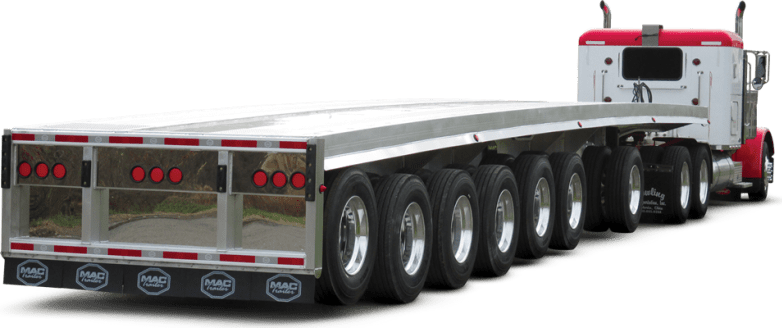
Two ways to move a jobsite load
Local Courier vs. Freight Broker
A local courier runs its own small vehicles on local routes; a freight broker matches each load to the right authorized carrier for that run. For a jobsite delivery, the difference decides whether your load fits the courier's own trucks — or gets the vehicle it actually needs, arranged for the run. This page explains when each fits.
Overview
Its own vehicles, or the right carrier for the load
A local courier owns a set of vehicles — usually cars, vans and small trucks — and runs local, often same-day routes with them. That's efficient for small parcels and light loads, but the load has to fit what the courier owns. A freight broker owns no trucks; it arranges each run by matching the load to an FMCSA-authorized carrier with the right vehicle for it, from a cargo van to an open deck. For a jobsite delivery — palletized material, long lengths, a mix of sizes — the broker model means the vehicle is chosen for the load rather than the load squeezed into whatever's in the courier's yard. Which fits depends on the load and the distance.
- Local courier vs. freight broker
- A local courier owns a fleet of small vehicles — cars, vans and light trucks — and runs local, often same-day routes with them; the load has to fit what the courier owns. A freight broker owns no vehicles and arranges each run by matching the load to an FMCSA-authorized carrier with the right vehicle, from a cargo van to an open deck. For construction material — palletized, long, heavy or mixed loads — the broker model fits the vehicle to the load rather than the load to a small owned fleet. Capital Site Logistics is a licensed property broker: it coordinates and quotes the run, and the authorized carrier hauls it. Which fits follows the load, the vehicle it needs, and the distance.
Side by side
Courier vs. broker, dimension by dimension
| Dimension | Local courier | Freight broker |
|---|---|---|
| The vehicles | Its own fleet — usually cars, vans and small trucks. | Any authorized carrier's vehicle, matched to the load. |
| The load | Has to fit what the courier owns. | The vehicle is chosen for the load, not the reverse. |
| Reach | Local routes, often same-day. | Local to long-haul — the lane is matched to a carrier. |
| Best load | Small parcels, documents, light packages. | Palletized, long, heavy or mixed jobsite loads. |
| Accountability | The courier and its drivers. | One broker coordinates and stays accountable for the run. |
Not sure which one your run needs? Send the details.
Choosing
Own van, or the right carrier
A local courier fits when
Local courier
- The load is small — parcels, documents, a light package.
- The run is local and the courier's own vehicles can carry it.
- Speed on a small local route matters more than vehicle choice.
A freight broker fits when
Freight broker
- The load is palletized, long, heavy, or a mix of sizes.
- The run needs a specific vehicle a small courier fleet may not have.
- You want one contact who matches the right carrier and owns the run.
Does this describe your run?
When a broker fits better than a courier
A local courier runs its own small vehicles on short hops; a broker arranges the right carrier for the load, at any size. If several of these fit, a broker is usually the better match.
The load is bigger than a van or car
Palletized material, bundled goods or anything needing a forklift outgrows a courier's vehicle — a broker matches it to a truck that fits.
It's going farther than across town
Couriers are built for the short local hop. A longer haul, or a run that crosses markets, is carrier work a broker arranges.
The run needs the right equipment at the ends
Dock height, liftgate, or specific handling at pickup or drop is matched to the vehicle when a broker arranges the carrier — noted at quoting, never assumed.
A courier still wins for the small, fast local drop
An envelope or a single small box across town is a courier's job, not a broker's. Match the tool to the run — and when it's freight, the broker is the tool.
FAQ
Courier or broker: what fits
Don't see your question? Send us the details and we'll get you a clear answer.
Request a Quote
Have a jobsite load that needs the right vehicle?
Send what's moving, the size and weight, and where it's going. We'll match it to the right authorized carrier and send a quote for the run.
Free, no-obligation quotes · Nationwide